Ozempic neck is one of the least talked about skin changes from GLP-1 weight loss — and one of the most distressing to notice in photos. Your face gets all the attention in these conversations, but the neck and jawline often show changes just as dramatically, sometimes more so, because neck skin is structurally different from facial skin in ways that make it uniquely vulnerable to rapid volume loss.
If you are on Ozempic, Wegovy, Mounjaro, or Zepbound and you have noticed loose skin, horizontal creasing, crepey texture, or visible banding along your neck — you are not imagining it, and you are not alone. This is a real structural response to fat loss in an area that was already working with less collagen, less oil, and thinner tissue than your face.
Here is what is actually happening underneath the skin, what topical ingredients have clinical evidence behind them, what professional treatments are genuinely worth considering, and what you can do starting today to support your neck skin while your body continues to change.
What Is Ozempic Neck and Why Does It Happen?
Ozempic neck is not a medical diagnosis — it is a descriptive term for the loose, sagging, or crepey skin that appears around the neck and jawline after significant weight loss on GLP-1 medications. The medication itself is not damaging your skin. What is happening is that the subcutaneous fat beneath your neck skin — the fat that was providing structural support and volume — is diminishing faster than your skin can adapt.
Think of it this way: your skin has been stretched over a certain volume for years, sometimes decades. When that volume decreases rapidly, the skin does not instantly shrink to match. It needs time, collagen remodeling, and elastin recovery to tighten. For some people, particularly those over 40, the skin's capacity to do this on its own is limited.
The visible signs of ozempic neck typically include one or more of the following: loose skin along the jawline that creates a less defined contour, horizontal lines or creases across the front of the neck, a crepey or tissue-paper texture especially in side lighting, and more prominent platysmal bands — those vertical cords that run from your collarbone to your jaw.
These changes are not unique to GLP-1 medications. They happen with any rapid weight loss — bariatric surgery, aggressive dieting, even illness-related weight loss. But GLP-1 medications can produce significant fat loss over a compressed timeline, which is why these neck changes have become such a visible part of the conversation.
Why Your Neck Shows Changes Before Your Face
This is the part that catches people off guard. You may have invested in a solid facial skincare routine for years. Your face looks fine. But the neck tells a completely different story. There is a biological reason for this.
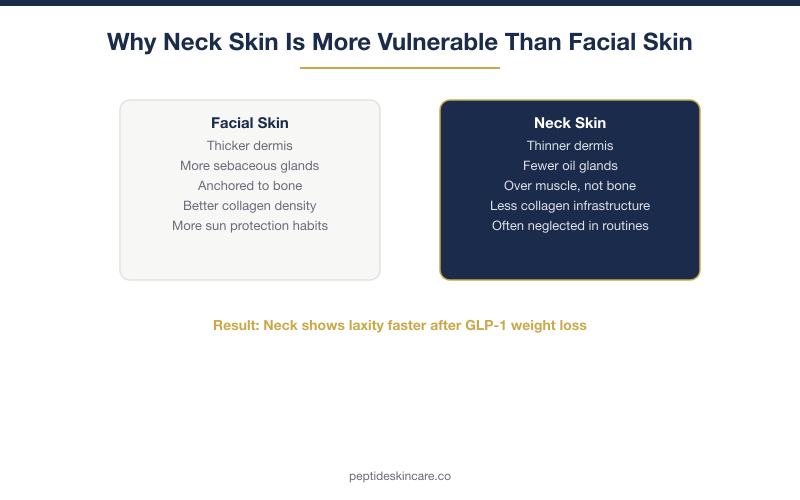
Neck skin is measurably thinner than facial skin. The dermis — the layer where collagen and elastin live — is significantly less dense in the neck, comparable in some measurements to the delicate skin around the eyelids. This thinner structure means there is simply less collagen infrastructure to provide snap-back when volume is lost.
The neck also has far fewer sebaceous glands than the face. Those oil-producing glands do more than manage shine — they contribute to the skin's lipid barrier, its baseline hydration, and its overall resilience. With fewer sebaceous glands, neck skin is naturally drier, less protected, and less able to maintain moisture under stress.
Add to this the fact that neck skin is not anchored to bone the way facial skin is. It sits over the platysma muscle and connective tissue, which means gravity has more influence here. After fat loss, that combination of thinner skin, weaker barrier function, less structural support, and gravitational pull creates the perfect conditions for visible laxity.
One more factor: most people have not been applying sunscreen, retinoids, or peptides to their neck with the same consistency as their face. Decades of relative neglect compound the structural disadvantages that were already there.
If you are working on repairing your skin barrier, your neck needs to be part of that plan — arguably more urgently than your face does.
The Topical Skincare Protocol for Ozempic Neck
Let me be direct about expectations: topical skincare cannot replace lost volume, and it cannot produce the tightening that a surgical procedure can. What it can do — and what the clinical evidence supports — is improve skin texture, stimulate collagen and elastin synthesis, strengthen the barrier, and slow further degradation. For mild to moderate ozempic neck, a well-constructed topical routine can produce meaningful visible improvement. For more advanced laxity, it becomes an important complement to professional treatments.
Here is the protocol, built around ingredients with genuine clinical evidence for neck skin.
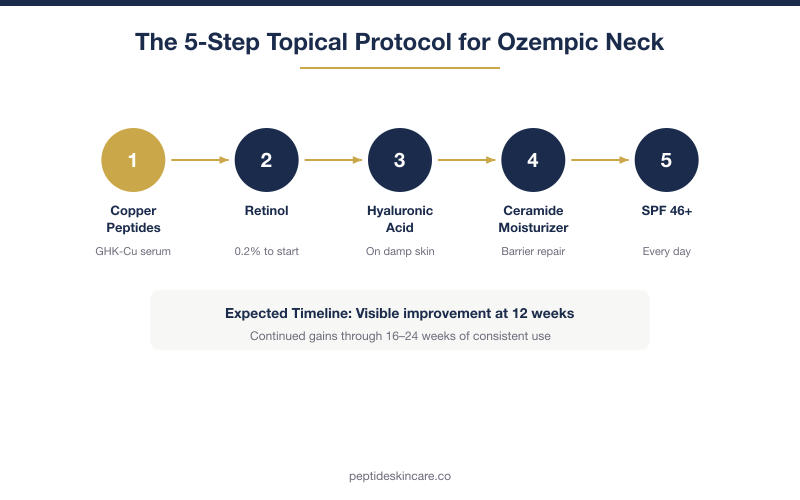
Copper Peptides: The Collagen and Elastin Signal
Copper peptides, specifically GHK-Cu, are the most relevant active for neck laxity because they address the core problem — diminished collagen and elastin production. A clinical study found that a GHK-Cu cream applied to skin for 12 weeks improved collagen production in 70% of women treated, outperforming both vitamin C cream and retinoic acid in the same trial. Separate research confirmed that GHK-Cu improved skin laxity, firmness, and density while increasing skin thickness, according to research published in BioMed Research International.
For neck skin specifically, this matters because the thinner dermis means you are working with less collagen to begin with. Stimulating new synthesis is not optional — it is the foundation of any meaningful improvement.
If you want to understand the full science behind how peptide ingredients work for GLP-1 skin, that article breaks down the mechanisms in detail.
Product recommendations:
- Budget: The Ordinary Multi-Peptide + Copper Peptides 1% (~$32) — apply to neck and jawline every evening
- Mid-range: NIOD Copper Amino Isolate Serum (~$60) — higher concentration for more advanced concerns
Retinol: The Collagen Rebuilder
Retinol is the most well-studied topical ingredient for skin aging, and there is specific clinical data for neck skin. A 2023 study published in the Journal of Cosmetic Dermatology evaluated a topical treatment containing retinol and tripeptide applied specifically to the neck. After 12 to 16 weeks, researchers found statistically significant improvement in fine lines, crepiness, laxity, and texture. Biopsy analysis showed increased expression of elastin and lumican — two proteins directly involved in skin firmness and structure.
The caveat with retinol on the neck: start lower and go slower than you would on your face. Neck skin is more reactive, and the thinner barrier means irritation risk is higher. Begin with a low-concentration retinol two to three nights per week and gradually increase frequency over six to eight weeks.
Product recommendations:
- Budget: The Ordinary Retinol 0.2% in Squalane (~$6) — ideal starting point for neck application
- Mid-range: Paula's Choice Clinical 1% Retinol Treatment (~$58) — for those who have built tolerance
Hyaluronic Acid and Ceramides: The Barrier Foundation
Because neck skin produces less natural oil, hydration is not cosmetic — it is structural. Dehydrated skin looks more crepey, wrinkles appear deeper, and the barrier is more vulnerable to environmental damage.
Hyaluronic acid draws and binds moisture into the skin. When used on damp skin, it plumps the tissue and reduces the appearance of fine lines. Ceramides reinforce the lipid barrier, preventing that moisture from escaping. Together, they address the specific weakness of neck skin — its inherently drier, less protected composition.
Product recommendations:
- Hyaluronic acid: The Ordinary Hyaluronic Acid 2% + B5 (~$12) — apply to damp neck skin morning and evening
- Moisturizer: CeraVe Moisturizing Cream (~$18) — ceramide-rich, locks everything in
- Mid-range moisturizer: First Aid Beauty Ultra Repair Cream (~$38) — excellent for very dry or compromised skin
Niacinamide: The Barrier Strengthener
Niacinamide supports ceramide production, reduces transepidermal water loss, and has anti-inflammatory properties that help calm reactive neck skin — especially useful when you are introducing retinol. Research has shown it can improve skin elasticity and reduce the appearance of fine lines over time.
Product recommendation:
- The Ordinary Niacinamide 10% + Zinc (~$6) — apply in the morning before moisturizer
Sunscreen: Non-Negotiable
UV exposure accelerates every problem described in this article — collagen breakdown, elastin degradation, barrier damage, pigmentation. If you are investing in peptides and retinol for your neck and not applying sunscreen to the same area, you are working against yourself.
Product recommendations:
- Budget: Neutrogena Clear Face SPF 55 (~$12) — lightweight, easy to extend below the jawline
- Mid-range: EltaMD UV Clear SPF 46 (~$39) — excellent for sensitive skin, will not irritate a retinol-treated neck
Professional Treatments Worth Considering for Ozempic Neck
Topical skincare works on a timeline of weeks to months and produces gradual, cumulative improvement. If your neck changes are moderate to severe — significant loose skin, deep banding, or dramatic loss of jawline definition — professional treatments can produce faster and more pronounced results. Here is what the evidence actually supports.
Radiofrequency Microneedling
Radiofrequency microneedling (devices like Morpheus8, Potenza, and Vivace) delivers RF energy through tiny needles directly into the dermis, stimulating collagen and elastin production at controlled depths. A prospective clinical study published in Dermatologic Surgery evaluated fractional radiofrequency microneedling specifically for the lower face, jawline, and neck region. Physicians, blinded investigators, and patients all rated clinical outcomes as highly improved, with measurable submental volume reduction. The treatment was well-tolerated with minimal downtime.
For neck skin, the recommended needle depth is typically around 1.5mm — shallower than facial treatment — because of the thinner dermis. Most protocols involve two to three sessions spaced four to eight weeks apart.
Typical cost: $800–$1,500 per session depending on geographic area and provider.
Ultrasound Therapy (Ultherapy)
Ultherapy uses focused ultrasound energy to target the deeper connective tissue layers, including the SMAS layer that sits beneath the platysma muscle. It can produce a modest lifting effect without incisions. Results develop over two to three months as new collagen forms. It is best suited for mild to moderate laxity — if you are seeing early looseness rather than significant sagging, this may be the right starting point.
Typical cost: $1,500–$3,000 for a neck treatment.
Biostimulators (Sculptra, Radiesse)
Injectable biostimulators work differently from fillers — rather than adding volume directly, they stimulate your own collagen production over time. Sculptra (poly-L-lactic acid) and Radiesse (calcium hydroxylapatite) can be used off-label in the neck area to improve skin quality and mild laxity. Results are gradual, appearing over several months, and can last one to two years.
Typical cost: $700–$1,200 per treatment session; most protocols require two to three sessions.
Surgical Neck Lift
For significant skin redundancy — when there is truly more skin than the underlying structure can support — a surgical neck lift (often combined with platysmaplasty to address the platysma muscle) remains the most definitive treatment. This is not where most people need to start, but it is important to know the option exists. Board-certified plastic surgeons can evaluate whether your level of laxity would benefit from surgical correction versus less invasive approaches.
Typical cost: $5,000–$12,000+ depending on the extent of the procedure.
Microneedling (Without RF)
Standard microneedling creates controlled micro-injuries that trigger a wound-healing response, stimulating collagen and elastin production. It is less aggressive than radiofrequency microneedling, which makes it both more affordable and more appropriate for early-stage changes. For neck skin, conservative needle depths of 0.5 to 1.0mm are recommended, with sessions spaced six to eight weeks apart.
Typical cost: $200–$500 per session.
Lifestyle Factors That Support Ozempic Neck Recovery
Your skincare routine and professional treatments work better when your body has the raw materials it needs to rebuild collagen and maintain skin structure from the inside.
Protein Intake
Collagen is a protein, and your body needs adequate dietary protein to synthesize it. Research consistently shows that protein intake supports skin structure during weight loss. Aim for at least 0.7 to 1.0 grams of protein per pound of lean body mass daily. If you are on a GLP-1 medication that suppresses appetite, this may require conscious effort — protein shakes, Greek yogurt, eggs, and lean meats are efficient sources.
Collagen Supplementation
Oral collagen peptides have shown measurable improvements in skin hydration, elasticity, and wrinkle depth across multiple clinical trials. The evidence is not neck-specific, but the mechanism — providing bioavailable peptides that stimulate fibroblast activity — is relevant to any area experiencing collagen loss. If you are curious about the research, our guide to collagen supplements for GLP-1 skin covers the clinical evidence in detail.
Hydration
This sounds basic, but GLP-1 medications can reduce fluid intake along with appetite. Adequate water intake supports skin hydration from the inside, and dehydrated skin shows every line and texture change more prominently.
Resistance Training
Building and maintaining muscle mass in the neck, shoulders, and upper body provides structural support underneath the skin. It does not replace lost fat, but it can improve the overall contour and reduce the appearance of laxity. Even basic exercises — neck stretches, shoulder presses, resistance band work — contribute over time.
Slower Weight Loss When Possible
If your prescribing physician is open to it, a more gradual rate of weight loss — around one to two pounds per week — gives your skin more time to adapt. This is not always feasible or desirable, and it is a conversation to have with your healthcare provider based on your individual health goals.
When to See a Specialist
Most mild ozempic neck responds well to a consistent topical routine and lifestyle modifications over three to six months. Consider consulting a board-certified dermatologist or plastic surgeon if:
- You have significant skin redundancy that is not improving with topical care
- Platysmal bands are becoming more prominent over time
- The laxity is affecting your confidence or daily comfort
- You want a professional assessment of which treatment tier — topical, minimally invasive, or surgical — is appropriate for your specific anatomy
The best outcomes come from providers who evaluate the face and neck as a whole and who understand the specific dynamics of post-GLP-1 skin changes. Ask whether they have experience treating patients on semaglutide or tirzepatide specifically, as the pattern of fat loss and skin response differs from diet-related or surgical weight loss.
If you are also noticing changes in your face, our comprehensive guide to addressing Ozempic face covers the full range of facial concerns and treatment approaches.
Frequently Asked Questions About Ozempic Neck
Q: Does ozempic neck go away on its own?
Mild laxity may improve somewhat once your weight stabilizes and your skin has time to remodel — a process that can take six to twelve months. However, for many people over 40, the skin's natural capacity to fully retighten is limited. A targeted skincare routine and, in some cases, professional treatments are typically needed to see meaningful improvement.
Q: Can you prevent ozempic neck while still on the medication?
You cannot fully prevent it if you are losing significant volume from the neck and jawline area, but you can meaningfully reduce its severity. Start a peptide and retinol routine before changes become visible, maintain protein intake, use sunscreen on your neck daily, and discuss the pace of weight loss with your prescriber.
Q: What is the best skincare ingredient for ozempic neck?
Copper peptides (GHK-Cu) have the strongest clinical evidence for improving skin laxity, firmness, and collagen production specifically. Combined with retinol for long-term collagen rebuilding, hyaluronic acid for hydration, and ceramides for barrier repair, they form the core of an evidence-based neck protocol.
Q: Is ozempic neck different from normal aging of the neck?
The visual changes are similar — loose skin, crepey texture, horizontal lines — but the timeline is compressed. Normal age-related neck changes develop gradually over years. Ozempic neck can appear over months, because rapid fat loss removes the structural support faster than the skin can adapt. The underlying biology (collagen loss, elastin degradation, reduced barrier function) is the same in both cases.
Q: How long does it take for skincare to improve ozempic neck?
Most clinical studies on neck-specific treatments (retinol, peptides) show measurable improvement at the 12-week mark, with continued gains through 16 to 24 weeks of consistent use. Professional treatments like radiofrequency microneedling can produce visible changes sooner, typically within four to eight weeks of a treatment session. Patience and consistency are essential — this is not an overnight fix.
Sources
- Pickart, L., Vasquez-Soltero, J.M., & Margolina, A. (2015). "GHK Peptide as a Natural Modulator of Multiple Cellular Pathways in Skin Regeneration." BioMed Research International, 2015, 648108. https://pmc.ncbi.nlm.nih.gov/articles/PMC4508379/
- Sullivan, M., et al. (2023). "Evaluation of a retinol containing topical treatment to improve signs of neck aging." Journal of Cosmetic Dermatology, 22(10), 2812-2822. https://pubmed.ncbi.nlm.nih.gov/37461826/
- Nguyen, L., et al. (2022). "Radiofrequency Microneedling for Skin Tightening of the Lower Face, Jawline, and Neck Region." Dermatologic Surgery, 48(12), 1299-1305. https://pubmed.ncbi.nlm.nih.gov/36449871/
Related Articles
- Ozempic Face: What Causes It and How to Fix It
- The 4 Peptide Ingredients That Actually Work for GLP-1 Skin
For informational purposes only. Not medical advice. Always consult your healthcare provider before changing your skincare routine or medication.