Ozempic Skin Side Effects in FDA Data: Hair Loss, Rash and Itch Reports for Semaglutide and Tirzepatide
Start with our pillar guide: How to Fix Ozempic Face: What the Evidence Supports (2026), or browse all GLP-1 & Skin articles.
⚠️ Read this first: these are report counts, not risk. This study counts voluntary reports to the FDA. It doesn't measure how often a side effect happens, and it doesn't prove that any drug caused anything. FAERS reports show what patients and clinicians reported while on a drug. They don't show that the drug caused the event, and they can't be used to estimate how often it happens.
Ozempic Skin Side Effects in FDA Data: Hair Loss, Rash and Itch Reports for Semaglutide and Tirzepatide
By Peptide Skincare Editorial Team · Published 2026-10-10 · Last updated 2026-10-10
Hair loss (alopecia) nearly tripled as a share of FDA adverse event reports for tirzepatide (Mounjaro, Zepbound), rising from 0.97% in 2024Q4 to 2.72% in 2026Q1 and 2.63% in 2026Q2. Semaglutide's share of reports was 0.84% in 2026Q2. Among Ozempic skin side effects reported for semaglutide overall, itching and rash top the list. Evidence: reporting signal only (FAERS).
We pulled every report naming semaglutide (Ozempic, Wegovy, Rybelsus) or tirzepatide (Mounjaro, Zepbound) from the FDA Adverse Event Reporting System (FAERS) and counted 17 skin and hair terms. All of the data is free to download below. If you're here because of your own hair, start with what we know about hair shedding on Ozempic.
Key findings - About 1 in 17 semaglutide reports and 1 in 24 tirzepatide reports list a skin or hair problem. That's 6,023 semaglutide reports (6.0%) and 6,781 tirzepatide reports (4.2%), with injection-site reactions left out. - Hair loss is the top skin and hair term for tirzepatide. 2,635 tirzepatide reports list alopecia (1.64% of its reports), compared with 1,085 for semaglutide (1.08%). - Alopecia shows a disproportionality signal for both drugs. The reporting odds ratio is 1.77 (95% CI 1.70–1.84) for tirzepatide and 1.15 (1.08–1.22) for semaglutide. That's a signal worth watching, not a measure of risk. - For semaglutide, itching and rash outnumber hair loss. Pruritus appears in 1,536 reports (1.52%) and rash in 1,477 (1.46%). - "Ozempic face"-type terms are rare. Skin laxity appears in 55 semaglutide and 47 tirzepatide reports.
Never stop, start or change a GLP-1 medication for skincare reasons; talk to your prescriber.
How many FDA reports did we analyze?
We analyzed 100,857 FAERS reports naming semaglutide (2018Q1–2026Q2) and 160,782 naming tirzepatide (2022Q3–2026Q2). Each report is one submission to the FDA, and a single submission can list several symptoms.
The number of reports per quarter rose steeply for both drugs. In 2026Q2 alone, FAERS logged 17,007 semaglutide reports and 19,957 tirzepatide reports. Semaglutide's quarterly totals jump around a lot, which we explain in the limitations section.
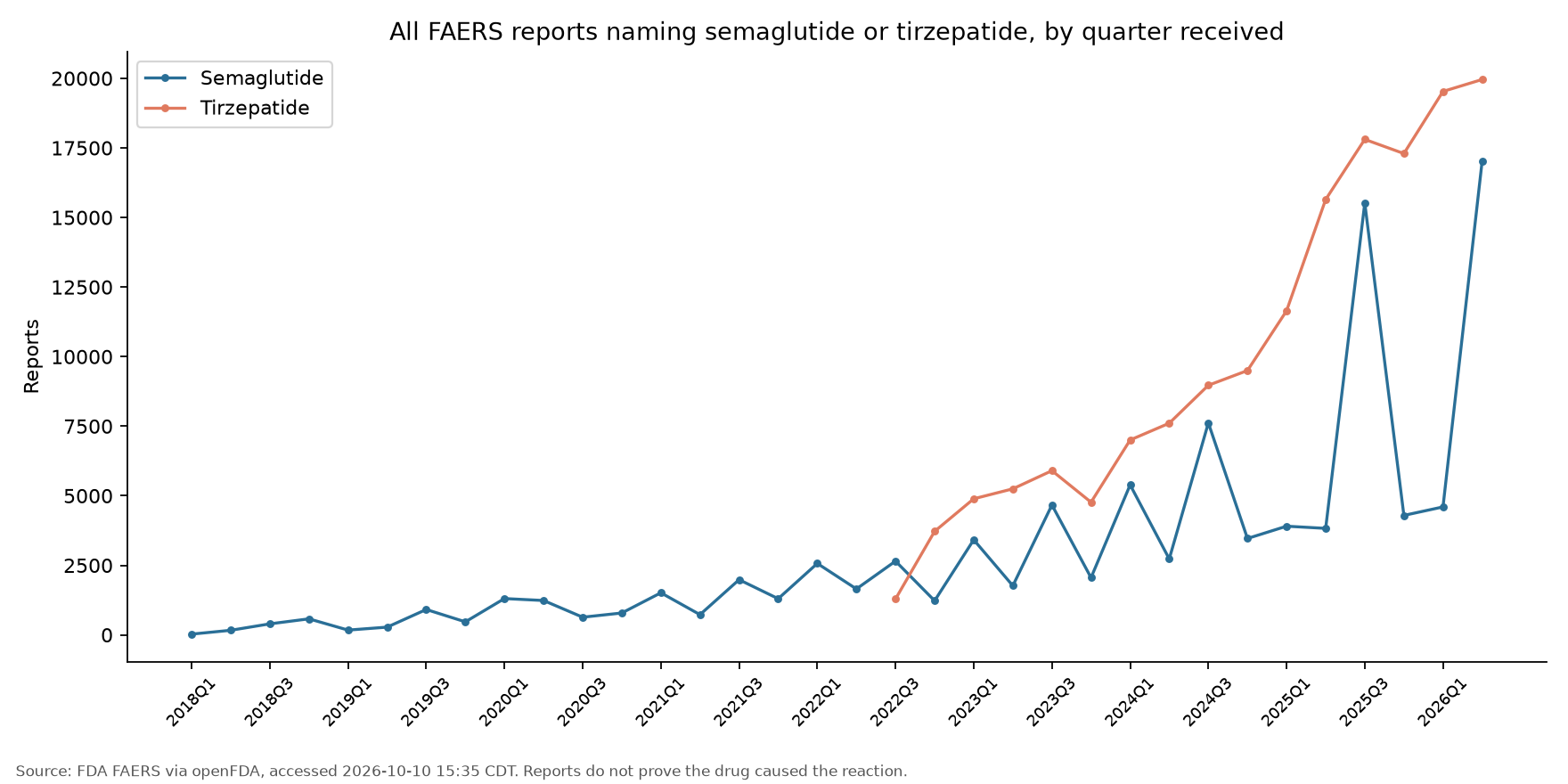 Figure 1. Total FAERS reports per calendar quarter naming semaglutide or tirzepatide (any role), by FDA receipt date. Source: FDA FAERS via openFDA. Data accessed Oct 10, 2026; FAERS data through July 30, 2026.
What are the most-reported Ozempic skin side effects in FDA data?
For semaglutide, pruritus (itching) is the most-reported skin or hair term, listed in 1,536 reports (1.52%), followed by rash in 1,477 (1.46%) and alopecia in 1,085 (1.08%). Hyperhidrosis, meaning excess sweating, comes fourth with 704 reports (0.70%).
Tirzepatide shows a different pattern. Alopecia leads at 2,635 reports (1.64%), well ahead of rash (1,294) and pruritus (1,224). Urticaria (hives) appears in 593 semaglutide reports and 787 tirzepatide reports.
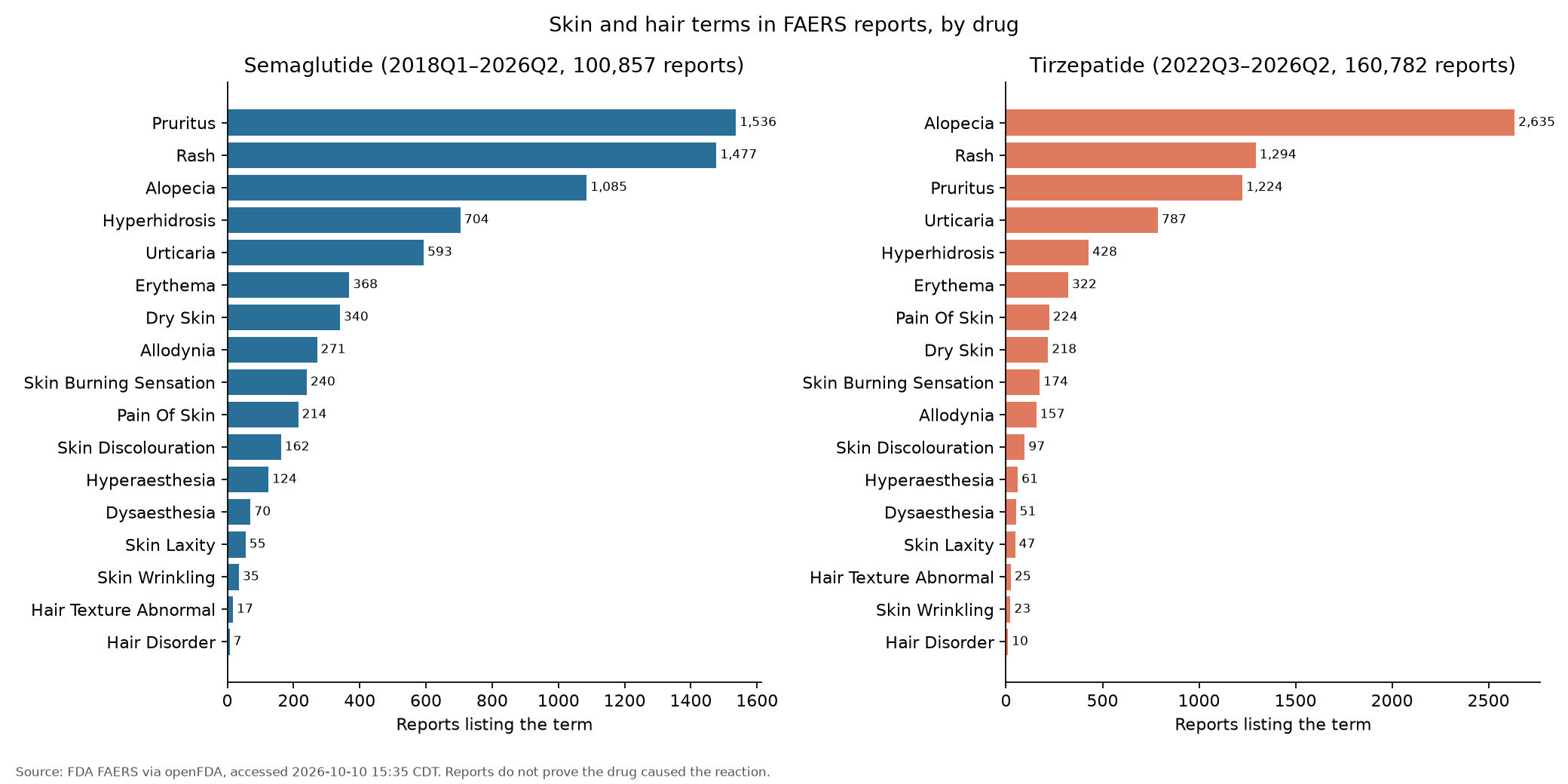 Figure 2. FAERS report counts for 17 skin and hair MedDRA terms, semaglutide vs tirzepatide. Injection-site reactions excluded. Source: FDA FAERS via openFDA. Data accessed Oct 10, 2026; FAERS data through July 30, 2026.
Is hair loss rising in FDA reports for Mounjaro and Zepbound?
Yes, as a share of reports. Alopecia went from 92 tirzepatide reports (0.97% of that quarter's tirzepatide reports) in 2024Q4 to 531 (2.72%) in 2026Q1 and 524 (2.63%) in 2026Q2.
The rise came in steps. Alopecia's share of tirzepatide reports was 1.48% in 2025Q1, 1.60% in 2025Q2 and 2.25% in 2025Q4. Semaglutide's share moved within a narrower band, from 1.89% in 2024Q1 down to 0.52% in 2026Q1 and 0.84% in 2026Q2.
A rising share doesn't tell you that more users are losing hair. It means hair loss makes up a bigger slice of what's being reported for tirzepatide. Media coverage, new patient groups, or a change in how one large reporter submits cases could all move this number. For brand-specific context, see our guide to Zepbound skin side effects.
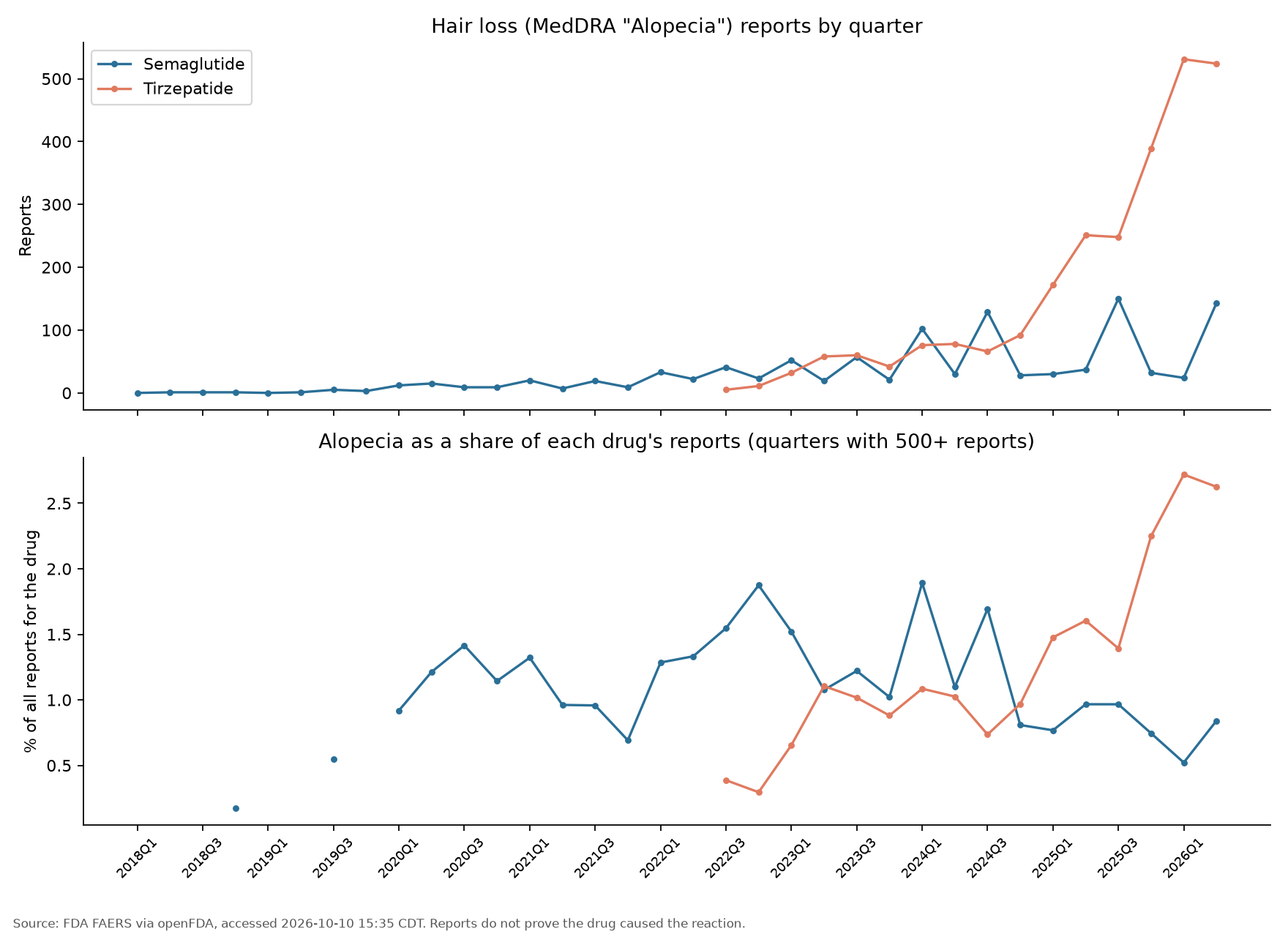 Figure 3. Alopecia as a share of each drug's FAERS reports, by quarter. Quarters with fewer than 500 total reports are hidden. Source: FDA FAERS via openFDA. Data accessed Oct 10, 2026; FAERS data through July 30, 2026.
Is hair loss reported more often than expected for GLP-1 drugs?
Yes, compared with the rest of FAERS. Alopecia's reporting odds ratio is 1.77 (95% CI 1.70–1.84) for tirzepatide and 1.15 (1.08–1.22) for semaglutide. Neither confidence interval crosses 1.
A reporting odds ratio (ROR) compares how often hair loss appears on one drug's reports with how often it appears on reports for every other drug in the database. An ROR of 1 means no difference. Above 1 means alopecia shows up proportionally more often for that drug. The comparison group includes every drug in FAERS, cancer drugs among them, so the baseline isn't "healthy people."
An ROR is a screening tool regulators use to flag patterns for a closer look. It isn't a risk estimate, and it can't tell you what your own odds are.
How do Ozempic skin side effects compare with Mounjaro and Zepbound reports?
Semaglutide has a higher share of reports for most skin terms, while tirzepatide has a higher share for hair loss. The table below lists all 17 terms. Share means the percentage of that drug's reports that list the term, rounded to 2 decimal places.
| MedDRA term (plain meaning) | Semaglutide reports | Semaglutide share | Tirzepatide reports | Tirzepatide share |
|---|---|---|---|---|
| Alopecia (hair loss) | 1,085 | 1.08% | 2,635 | 1.64% |
| Hair texture abnormal | 17 | 0.02% | 25 | 0.02% |
| Hair disorder | 7 | 0.01% | 10 | 0.01% |
| Rash | 1,477 | 1.46% | 1,294 | 0.80% |
| Pruritus (itching) | 1,536 | 1.52% | 1,224 | 0.76% |
| Urticaria (hives) | 593 | 0.59% | 787 | 0.49% |
| Erythema (redness) | 368 | 0.36% | 322 | 0.20% |
| Dry skin | 340 | 0.34% | 218 | 0.14% |
| Hyperhidrosis (excess sweating) | 704 | 0.70% | 428 | 0.27% |
| Skin discolouration | 162 | 0.16% | 97 | 0.06% |
| Skin laxity (loose skin) | 55 | 0.05% | 47 | 0.03% |
| Skin wrinkling | 35 | 0.03% | 23 | 0.01% |
| Dysaesthesia (abnormal, unpleasant touch sensation) | 70 | 0.07% | 51 | 0.03% |
| Hyperaesthesia (heightened skin sensitivity) | 124 | 0.12% | 61 | 0.04% |
| Allodynia (pain from light touch) | 271 | 0.27% | 157 | 0.10% |
| Pain of skin | 214 | 0.21% | 224 | 0.14% |
| Skin burning sensation | 240 | 0.24% | 174 | 0.11% |
| Any of the 17 terms (unique reports) | 6,023 | 5.97% | 6,781 | 4.22% |
| Injection-site reactions (grouped, kept separate) | 3,322 | 3.29% | 29,450 | 18.32% |
| Total reports in window | 100,857 | 160,782 |
Windows: semaglutide 2018Q1–2026Q2, tirzepatide 2022Q3–2026Q2. One report can list several terms, so individual rows don't add up to the "any" row.
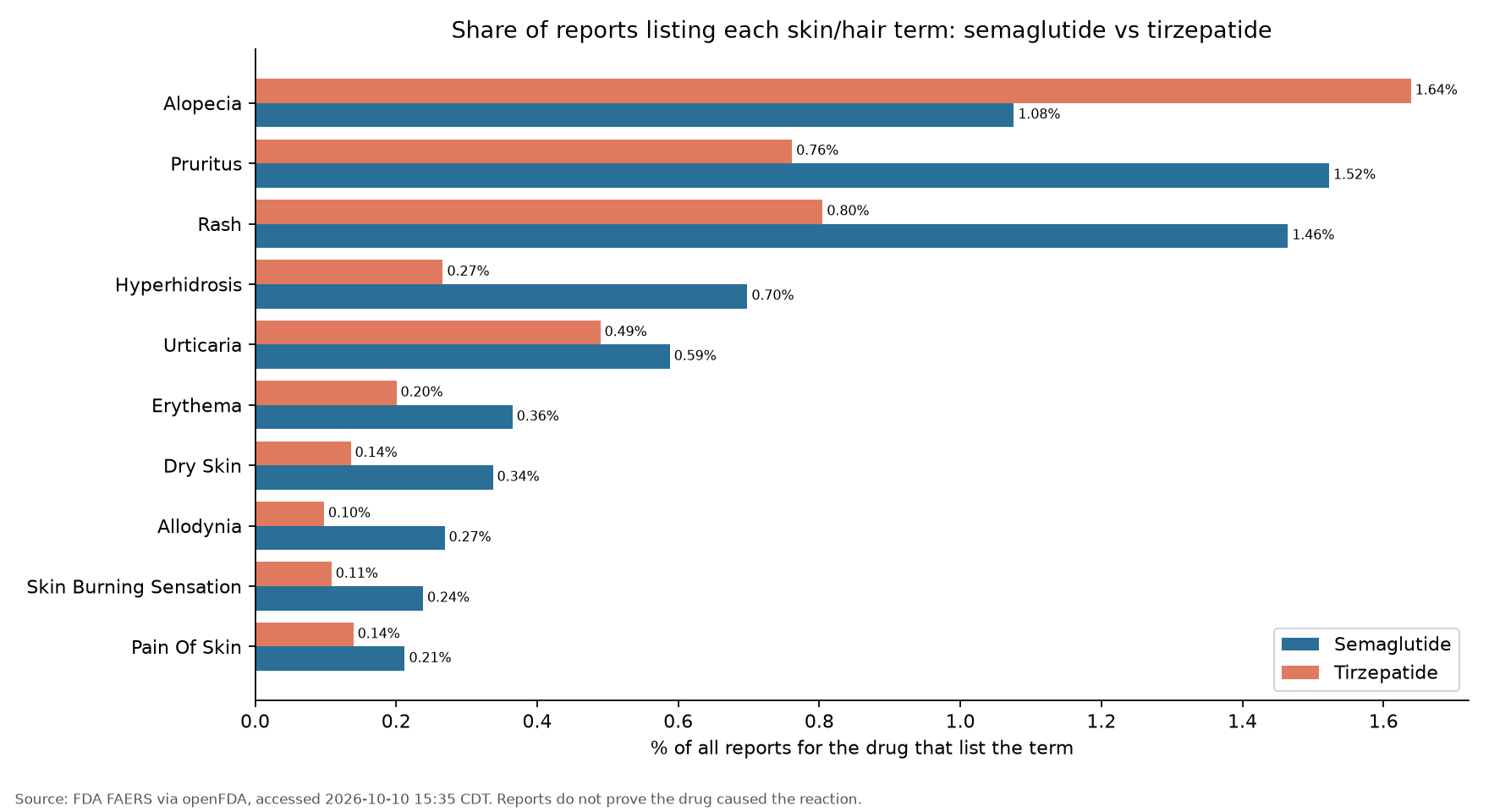 Figure 4. Share of each drug's FAERS reports listing each skin and hair term. Source: FDA FAERS via openFDA. Data accessed Oct 10, 2026; FAERS data through July 30, 2026.
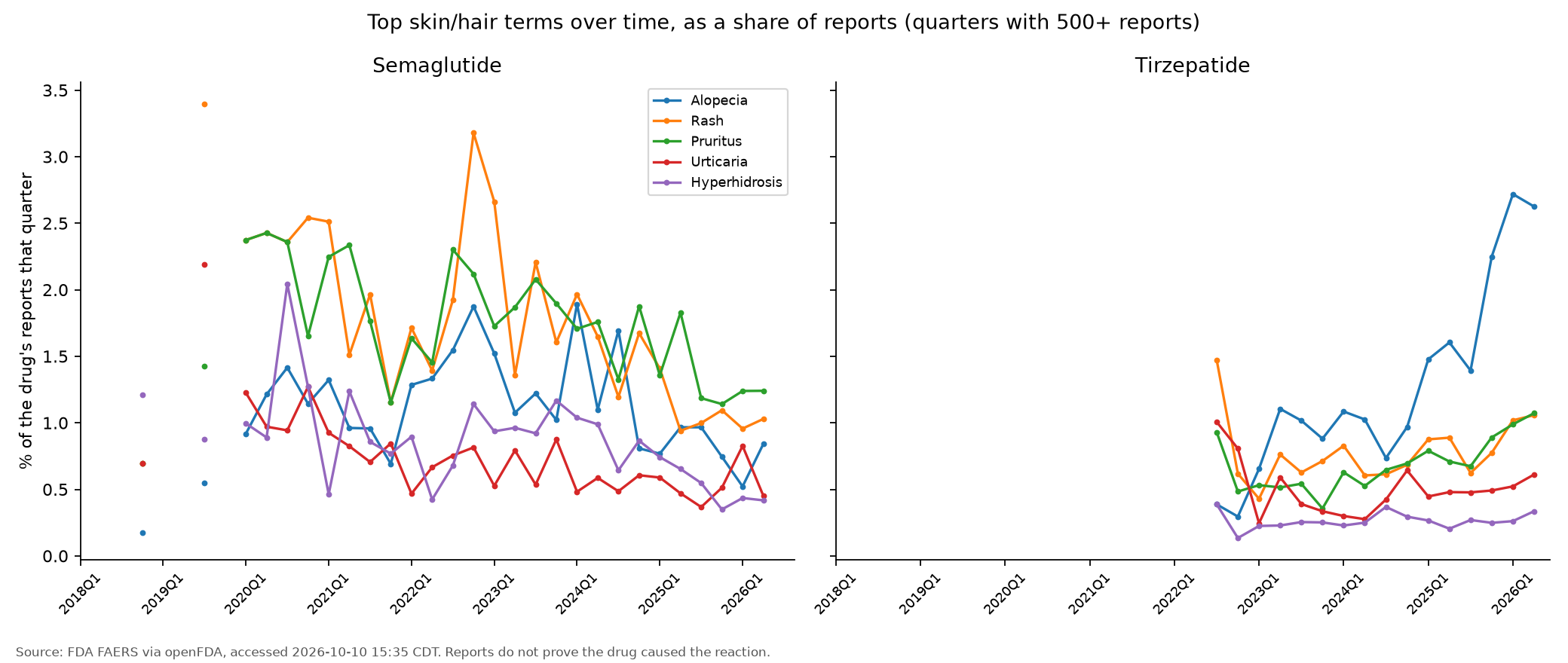 Figure 5. Quarterly share of reports for the most-reported skin and hair terms, by drug. Quarters with fewer than 500 total reports are hidden. Source: FDA FAERS via openFDA. Data accessed Oct 10, 2026; FAERS data through July 30, 2026.
What are the "skin hurts to touch" reports?
A small but steady group of reports describe skin that feels painful or oversensitive. Allodynia appears in 271 semaglutide and 157 tirzepatide reports, pain of skin in 214 and 224, and skin burning sensation in 240 and 174.
Two rarer terms belong here too: hyperaesthesia (124 and 61) and dysaesthesia (70 and 51). This matches a recurring question in GLP-1 communities about skin that suddenly feels sore to touch. FAERS can't explain what's behind these reports. We cover what readers describe in our piece on Mounjaro skin sensitivity.
Does "Ozempic face" show up in FDA reports?
Rarely, under the terms we searched. Skin laxity appears in 55 semaglutide and 47 tirzepatide reports, and skin wrinkling in 35 and 23.
"Ozempic face" usually refers to facial volume loss after rapid weight loss. People may not see it as a drug side effect worth reporting, or it may get coded under other terms. So low counts here don't mean the concern is rare in real life, only that it rarely reaches FAERS under these labels. For practical options, see our guide to treating Ozempic face.
What about injection-site reactions?
We counted injection-site reactions separately, because they're a different issue from whole-body skin and hair changes. They appear in 29,450 tirzepatide reports (18.3%) and 3,322 semaglutide reports (3.3%).
That group covers 10 MedDRA terms, including injection site pain, redness, itching, rash, swelling and bruising. Keeping them separate stops them from drowning out the skin findings above.
How we got this data (methods)
In short: we queried the public openFDA API, counted reports by quarter for each drug and each skin or hair term, and divided by that drug's total reports.
- Source and timing. FDA Adverse Event Reporting System via the openFDA drug adverse event API, queried Oct 10, 2026 at 3:35 PM CT. The dataset was last updated July 30, 2026. No API key was used.
- Drugs searched. Semaglutide: generic name SEMAGLUTIDE, or product names SEMAGLUTIDE, OZEMPIC, WEGOVY, RYBELSUS. Tirzepatide: generic name TIRZEPATIDE, or product names TIRZEPATIDE, MOUNJARO, ZEPBOUND.
- Any-role counting. We counted every report that names the drug, whether it was listed as the suspect drug or not. openFDA can't link a "suspect" flag to a specific drug on a report. As a check, a suspect filter changed all-time totals from 100,912 to 100,550 (semaglutide) and 160,934 to 160,472 (tirzepatide), a difference under 0.5%.
- The 17 terms. FAERS codes reactions using MedDRA, a standard medical dictionary. We picked preferred terms covering hair loss and texture, rash, itching, hives, redness, dryness, sweating, discoloration, loose or wrinkled skin, and painful or oversensitive skin. We checked that each spelling returns results across the whole database. "Hair thinning" isn't a preferred term (0 hits), so thinning mostly falls under alopecia.
- Quarters. We bucketed reports by FDA receipt date into calendar quarters. Windows start after approval (Ozempic in Dec 2017, Mounjaro in May 2022). 2026Q3 is left out because it's incomplete.
- Shares. Share = reports listing the term ÷ all reports for that drug in the same period.
- ROR. Calculated for alopecia using all-time, any-role counts (1,086 semaglutide and 2,639 tirzepatide alopecia reports), with 95% confidence intervals by the standard log method. That's why these counts differ slightly from the windowed totals.
Every URL we called is listed in order in the query log, and the full method is in methods.md (both linked below).
What are the limits of this data?
FAERS is built to spot early warning signs, not to measure risk. Keep these limits in mind before you share any number from this page.
- Duplicates. The same event can be reported by a patient, a doctor and the manufacturer, and openFDA doesn't fully remove duplicates.
- Stimulated reporting. News coverage, such as the 2023 "Ozempic face" and hair-loss stories or reporting on compounded drugs, plus patient-support programs, can push reports up with no change in what's actually happening.
- No denominator, and fast-growing use. FAERS doesn't know how many people take each drug. Use grew enormously over this period, so rising counts largely reflect more people on these medications.
- Batch submissions. Semaglutide's quarterly totals swing sharply, for example 3,828 in 2025Q2, 15,522 in 2025Q3 and 4,294 in 2025Q4. That pattern fits manufacturers submitting reports in batches, so treat any single-quarter move with caution.
- Lag. Reports can arrive months after the event, and this dataset only runs to July 30, 2026.
- Double counting. A report naming both drugs counts for both.
- Misspelled brand names. Product names entered in unusual formats (for example "OZEMPIC 1MG PEN") may be missed if openFDA hasn't mapped them.
- Coding. Terms reflect how reporters and processors coded each case, and one report can carry several terms.
Download the data
All files are free to reuse with attribution. No license is required, but please credit Peptide Skincare and link back to this page.
- faers_glp1_skin_hair_totals.csv: counts and shares for all 17 terms, the "any" group and injection-site reactions, by drug
- faers_glp1_skin_hair_by_quarter.csv: quarterly counts, totals and shares
- alopecia_reporting_odds_ratio.csv: the 2×2 counts, ROR and 95% CI for each drug
- methods.md: the full query definitions and caveats
- query_log.tsv: every openFDA URL we called, in order
How to cite this data Peptide Skincare Editorial Team. (2026). Skin and hair side effects in FDA reports for semaglutide and tirzepatide: an analysis of FAERS data. peptideskincare.co. https://peptideskincare.co/glp1-skin-hair-side-effects-fda-data/ (Data accessed Oct 10, 2026; FAERS data through July 30, 2026.)
Where the data stops
FAERS can show that hair loss makes up a growing share of tirzepatide reports. It can't show why, how common hair loss is among users, or whether it relates to the drug, to rapid weight loss, to diet, or to something else entirely.
We also can't tell from these reports how long symptoms lasted, whether they went away, or what dose people were on. Answering those questions takes controlled studies with a known number of users, which this dataset doesn't provide. We'll refresh these numbers when openFDA publishes new quarters, and we'll update the "Last updated" date only if the findings change.
FAQ
Does Ozempic cause hair loss, according to FDA data?
FDA FAERS data can't answer that. It shows 1,085 semaglutide reports listing alopecia (1.08% of semaglutide reports) and 2,635 tirzepatide reports (1.64%). A report only means someone noted hair loss while on the drug, not that the drug was responsible.
Why did hair loss reports rise for Mounjaro and Zepbound?
We don't know. Alopecia's share of tirzepatide reports rose from 0.97% in 2024Q4 to 2.63% in 2026Q2. FAERS can't separate a real change from media attention, growing use, changes in who reports, or batch submissions.
What are the most common Ozempic skin side effects in FAERS reports?
For semaglutide, the most-reported skin and hair terms were pruritus (itching, 1,536 reports), rash (1,477) and alopecia (1,085), followed by hyperhidrosis, or excess sweating (704). These are report counts, not rates.
Is "Ozempic face" reported to the FDA?
Rarely, at least under matching terms. Skin laxity appears in 55 semaglutide and 47 tirzepatide reports, and skin wrinkling in 35 and 23. Facial volume loss may be described in other ways or not reported at all.
Is Mounjaro worse for hair loss than Ozempic?
FAERS data can't tell you that. Alopecia has a higher share of tirzepatide reports and a higher reporting odds ratio (1.77 vs 1.15), but these are reporting patterns. The two drugs differ in who uses them, when they launched and how they're reported.
Should I stop my GLP-1 medication if my hair is thinning?
Never stop, start or change a GLP-1 medication for skincare reasons; talk to your prescriber. A clinician can look at other possible contributors and decide what makes sense for you.
Related reading
- What we know about hair shedding on Ozempic
- Zepbound skin side effects: what readers report and what to ask your doctor
- Mounjaro skin sensitivity and the "skin hurts to touch" question
- Treating Ozempic face: options for facial volume loss after weight loss
Medical disclaimer: This article is for general information only and isn't medical advice, diagnosis or treatment. FAERS data reflects voluntary reports and can't establish cause or how often an event occurs. Never stop, start or change a GLP-1 medication for skincare reasons; talk to your prescriber or another qualified clinician about any symptoms or treatment decisions. Peptide Skincare has no affiliate links in this article.